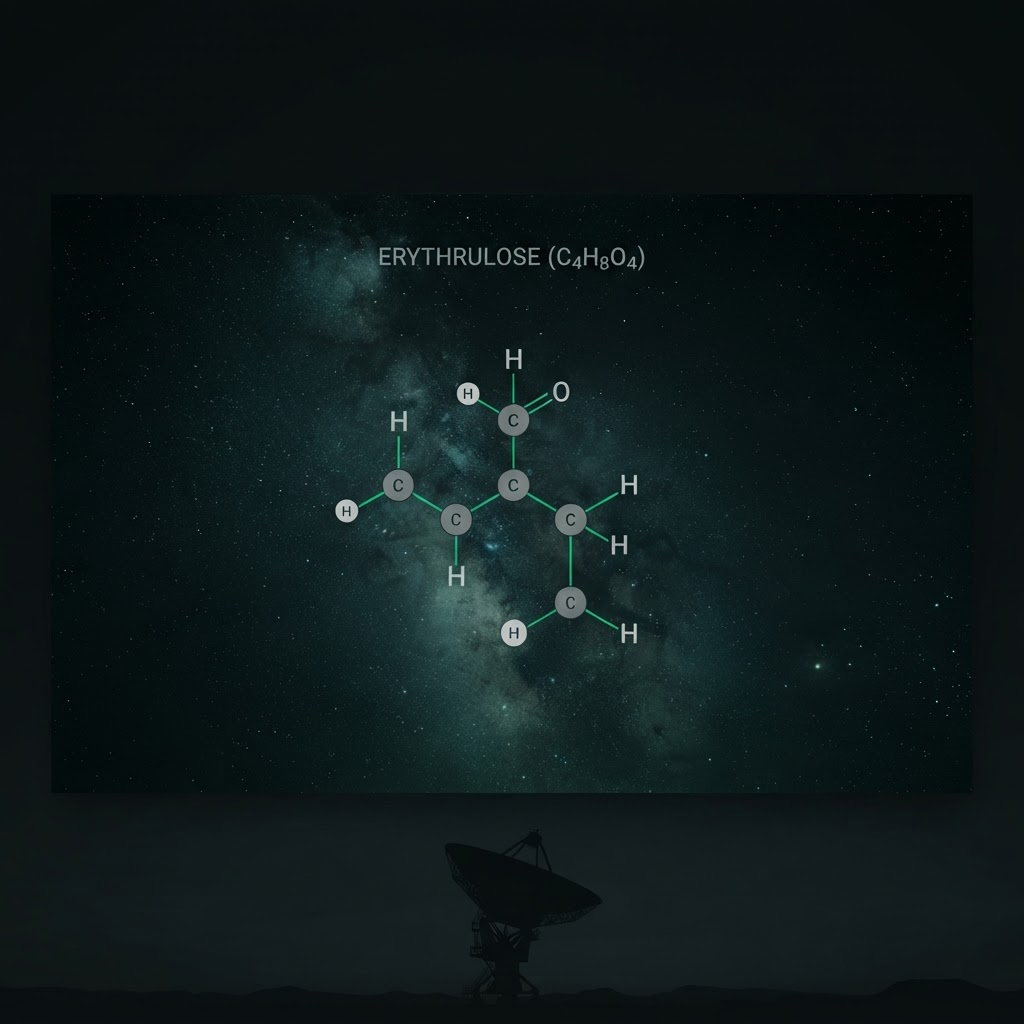
For the first time, astronomers have identified a genuine sugar in the space between the stars. A team led by Izaskun Jiménez-Serra of Spain’s Center for Astrobiology (CSIC-INTA) has detected erythrulose – a four-carbon sugar, chemical formula C₄H₈O₄, more familiar from raspberries and self-tanning lotion – in the molecular cloud G+0.693−0.027 near the center of the Milky Way, roughly 26,000 light-years away. Reported in Nature Astronomy on 13 July 2026, it is the first sugar ever found in the interstellar medium and only the second chiral molecule detected there. For an intelligence desk that has spent 2026 tracking the organic inventory of returned asteroid samples, the significance is precise: this supplies the missing top rung of a supply chain OED has been assembling result by result. The sugar was not made on a planet, a comet, or an asteroid. It was made in the cloud.
The signal
The SignalThe detection rests on 12 matched sets of radio emission lines picked up by the Yebes 40-metre and IRAM 30-metre radio telescopes in Spain. Molecules in cold, dense interstellar gas rotate at quantized frequencies, and each species radiates a fingerprint pattern of lines; erythrulose’s pattern was matched cleanly against laboratory spectroscopy. G+0.693−0.027, a chemically rich cloud near the galactic center, has become the most productive single hunting ground for complex interstellar molecules, and it delivered again. The result carries a formal citation – Nature Astronomy, doi:10.1038/s41550-026-02905-7 – and, as reported in the journal’s own news coverage, closes a gap that had stood since the first complex-organic surveys of the region.
Why “first sugar” is a precise claim, not a headline
The PrecisionThis is the paragraph that earns the byline. Glycolaldehyde – a two-carbon molecule sometimes loosely called “the simplest sugar” – has been known in space since 2000, and casual coverage has occasionally called space “sweet” ever since. But a true sugar requires a carbon backbone of at least three atoms; as Brett McGuire notes in Nature’s news coverage, glycolaldehyde does not formally qualify. Of the more than 340 molecules catalogued in the interstellar medium to date, not one was a sugar until now. Erythrulose, at 14 atoms, is the largest non-cyclic species yet found in the ISM and the first to contain four oxygen atoms. The precision is the whole point: the edge here is not repeating the headline, it is knowing exactly what was, and was not, claimed – and why a two-carbon molecule catalogued 26 years ago does not diminish what a four-carbon one confirmed this month.
Space has looked sweet since 2000. It took until 2026 to find something a chemist will actually call a sugar.
The chirality thread
The HandednessErythrulose is also only the second chiral molecule ever detected in the interstellar medium. The first was propylene oxide, found by McGuire and colleagues in the Sagittarius B2 cloud in 2016 and published in Science (doi:10.1126/science.aae0328). Chirality – molecular handedness – matters because life on Earth is homochiral: it builds with one mirror-image form almost exclusively, using left-handed amino acids and right-handed sugars, and the origin of that asymmetry is one of the hardest unsolved problems in origins research. A molecule that is both prebiotic and chiral, forming in deep space, is a data point in that question. It must be handled carefully. This detection does not explain homochirality, and no serious reading should claim it does. What it does is widen the arena in which the question can be asked – from planetary surfaces and meteorites outward to the galactic clouds that predate them.
The surprise in the data
The MechanismThe genuinely interesting scientific twist is in what the team did not find. Standard astrochemistry assumes molecules grow one carbon at a time, so the expectation was that simpler three-carbon sugars – glyceraldehyde and dihydroxyacetone – would dominate, with four-carbon species rare or absent. The data inverted that. None of the three-carbon sugars showed up at all, while four-carbon erythrulose was at least eight times, and by some coverage up to roughly seventeen times, more abundant than the undetected three-carbon species. The mechanism the team proposes, supported by their chemical modeling and framed in the ScienceAlert and Scientific American coverage, is a two-plus-two pathway: erythrulose assembles on the icy surfaces of interstellar dust grains from two two-carbon building blocks – glycolaldehyde and ethylene glycol, both already present in the cloud – rather than by sequential single-carbon addition. If that holds, it revises the assumed grammar of how complex organics build in space.
The standard one-carbon-at-a-time model predicts three-carbon sugars should precede and outnumber four-carbon ones. Instead the three-carbon species are absent and four-carbon erythrulose dominates – consistent with a two-plus-two assembly on icy grain surfaces from glycolaldehyde and ethylene glycol, both already observed in the cloud. Ratios per Nature Astronomy and secondary coverage.
The delivery number
The DeliveryHere is the figure that makes this matter beyond astrochemistry. Based on the measured abundance in G+0.693, the researchers estimate that between roughly 0.5 and 50 million metric tons of erythrulose could have reached Earth’s surface during the Late Heavy Bombardment, the ~4.1 to 3.8 billion-year-ago window when the inner solar system was pelted with comets and asteroids. Attributed to the Phys.org and CSIC coverage of the paper, that tonnage estimate reframes a long-standing puzzle. Laboratory experiments have never managed to synthesize sugars in sufficient quantity under plausible early-Earth conditions, leaving a gap between the chemistry life needed and the chemistry a young planet could make. An off-world source of pre-formed sugar, delivered by the megaton, closes that gap from the outside. This is the load-bearing sentence for the thesis: the raw material may not have had to be manufactured on Earth at all.
Earth never made enough sugar in the lab. The galaxy, it turns out, may have shipped it by the megaton.
OED assessment – where the science becomes a signal
OED Assessment · The Loop ClosesThis detection closes a loop OED has been tracking all year. We have published two briefs on the organic inventory of asteroid Ryugu: our 18 March brief on the confirmation of the complete DNA/RNA nucleobase alphabet in pristine Ryugu samples (Nature Astronomy), and the 11 June special edition on Ryugu’s giant 100-plus-ring macromolecules imaged by atomic force microscopy. Bennu, via NASA’s OSIRIS-REx return, independently yielded sugars and nucleobases. The chain now reads cleanly: galactic cloud → dust grain → comet/asteroid → planetesimal → early Earth. Erythrulose supplies the missing top rung – the raw interstellar feedstock – that the Ryugu and Bennu sample-return results only implied. The samples proved the organics arrive on carbonaceous bodies; this detection shows the galaxy was stocking those bodies from the start.
The Differentiator Moves Up The StackIn our March Ryugu nucleobases brief we flagged that organic chemistry had become a new axis for asteroid resource characterization – C-type asteroids valued for more than water and metals, priced increasingly on their molecular inventory. This detection extends that axis to its source. It does not create a near-term revenue line, and it would be dishonest to pretend otherwise. What it does is strengthen the scientific case that carbonaceous bodies are chemically pre-loaded from the interstellar medium, which is the long-horizon substrate beneath the asteroid-resource names. The taxonomy note from March now has an interstellar anchor.
Who This Touches – And Honestly How MuchLead with the counterargument: there is no direct commercial beneficiary of an interstellar sugar detection. No public pure-play, no ticker, no near-term contract moves because a sugar was found 26,000 light-years away. What the result does is de-risk, at the margin, the scientific premise beneath the deep-space-resources cohort OED already scores. The relevant exposure splits into two layers, and only one of them is a near-term signal.
| Entity / Layer | Role in the chain | Read on this result | OED Status |
|---|---|---|---|
| Yebes 40m · IRAM 30m · radio arrays | Detection instrument layer | Direct – the detection is the product; capability compounds with each new molecule resolved | Strategic |
| JAXA (Hayabusa2#) | Sample return · C-type heritage | Indirect – feedstock thesis reinforced; extended mission still generating | Instrument-layer |
| NASA (OSIRIS-REx / APEX) | Bennu sugars + nucleobases returned | Indirect – independent corroboration of the delivered-organics model | Instrument-layer |
| CNSA (Tianwen-2) | Reached quasi-moon 2016 HO₃; sample return inbound | Indirect – extends returned-sample inventory to a new body | Instrument-layer |
| Karman+ | Sub-$20M carbonaceous NEA mission + water demo | Thesis-supportive – targets now understood as chemically richer | Coverage-Pending |
| AstroForge | M-type metallic (PGM) extraction | Minimal – metallic thesis insulated from C-type organics | Coverage-Pending |
| TransAstra | Optical-mining volatiles extraction | Thesis-supportive – strengthens volatiles-rich target abundance | Coverage-Pending |
| Origin Space (CN) | Asteroid mining · on-orbit telescope | Thesis-supportive – rides CNSA sample-return momentum | Coverage-Pending |
| Interlune | Lunar helium-3 / regolith resources | Peripheral – resource-thesis sibling, not organics-exposed | Coverage-Pending |
Two layers, one signal. The instrument/detection layer (radio astronomy plus sample-return missions) is the real near-term compounding asset, exactly as the 11 June Ryugu special argued when it flagged instrumentation as “strategic.” The asteroid-resource cohort is affected only at the thesis level – their targets are now understood as more chemically pre-loaded than a pure water/metals model assumed. That is a long-horizon substrate signal, not a catalyst, and no scores change this cycle.
The instrument layer deserves the emphasis because it is where detection capability actually compounds. Radio-astronomy facilities – Yebes, IRAM, and by extension the roadmap toward next-generation arrays – plus sample-return missions like JAXA’s Hayabusa2#, NASA’s OSIRIS-APEX follow-on, and CNSA’s Tianwen-2, which recently reached the quasi-moon 2016 HO₃, are where the ability to find the next molecule is manufactured. Detection is the product; the science is the demo. The asteroid-resource names – Karman+, AstroForge, TransAstra, Origin Space, Interlune – are touched only at the thesis level, and OED marks them Coverage-Pending and thesis-supportive, not a scoring change. To do otherwise would be to price a catalyst that does not exist.
Each link was already independently evidenced except the first. Erythrulose supplies it: the feedstock existed in the galactic medium before the solar system formed. OED’s Astrobiology & Origins coverage now spans the full chain from cloud to cell, with the final rung – homochirality – explicitly marked open.
First true sugar (erythrulose, C₄H₈O₄) detected in the interstellar medium, in galactic-center cloud G+0.693 via Yebes 40m + IRAM 30m; Nature Astronomy, 13 Jul 2026. Also the 2nd chiral molecule in the ISM after propylene oxide (2016). Defies the one-carbon-at-a-time growth model – 3-carbon sugars absent, 4-carbon erythrulose ≥8× more abundant; forms on icy dust grains from 2+2 building blocks. Est. 0.5–50 million tonnes deliverable to early Earth. Closes OED’s galactic-cloud → asteroid → Earth organics chain (ties our 18 Mar Ryugu nucleobases + 11 Jun Ryugu macromolecules specials). No direct commercial beneficiary; the near-term signal is the detection/instrument layer. Asteroid-resource cohort (Karman+, AstroForge, TransAstra, Origin Space) thesis-supportive only.
The disciplined close, in OED’s voice: the market cannot price a sugar 26,000 light-years away. But it can price the sensing layer that found it – and that layer is, once again, the part of the iceberg below the waterline that OED exists to map. The science this month is spectacular and the tickers are unmoved, and both of those statements are correct at the same time. The job is to hold them together without pretending either one is the other.
This brief is the third in OED’s Astrobiology & Origins sequence and supplies the interstellar feedstock rung above the two Ryugu sample-return results. Sample-return and detection-layer siblings (Hayabusa2#, Tianwen-2) tracked under Deep Space & Resources.