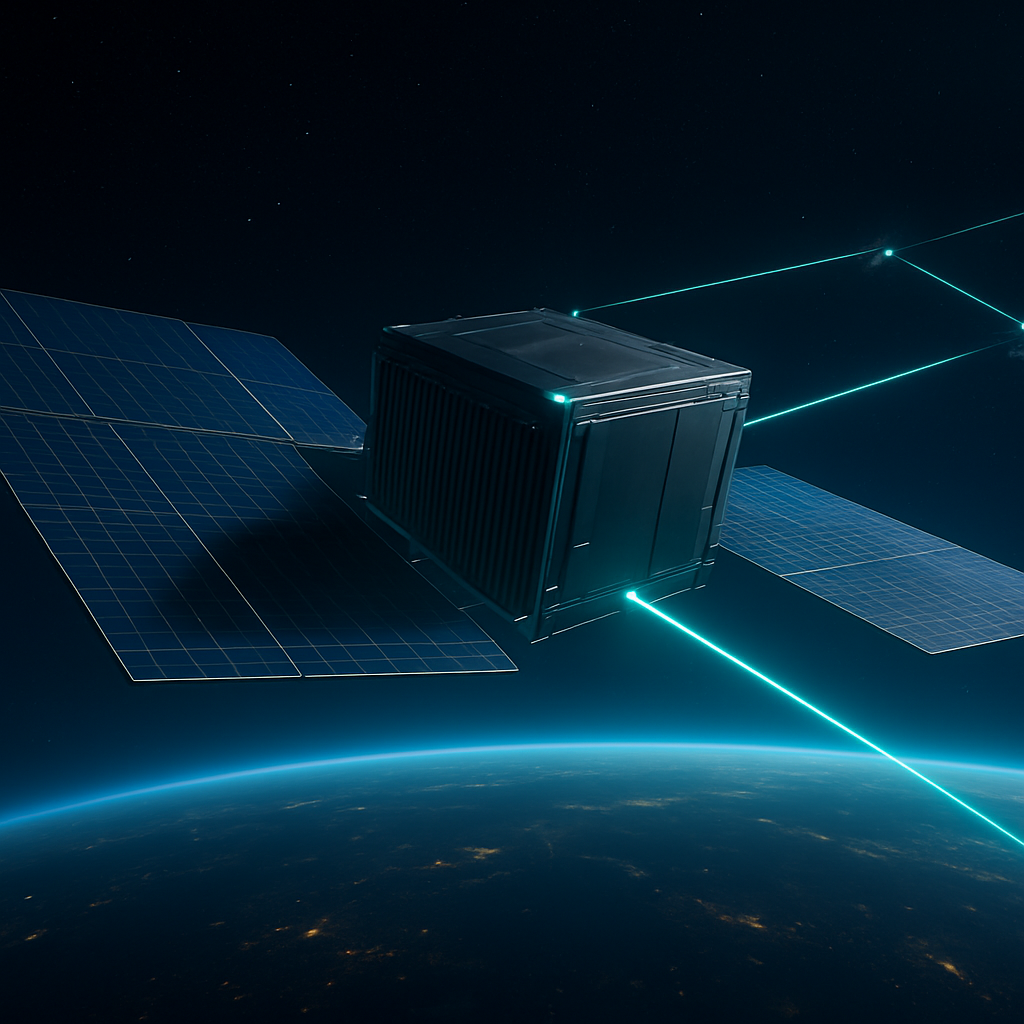
LA-based Orbital announced a $5M pre-seed yesterday to build an orbital-data-center (ODC) constellation, led by a16z’s Speedrun accelerator with a long tail of micro-VCs – Basis Set, Human Element, Antler, Anti Fund, Ascent, and a dozen more. The dollar figure is rounding error in a sector where SpaceX has filed for a million-satellite compute constellation and Starcloud just raised at a $1.1B valuation. What makes Orbital worth a brief is not the capital. It is the explicit architectural bet the founder is making against the rest of the field: not one giant satellite, but a mesh of small ones. That single design choice – distributed versus monolithic – is now the fault line running through the entire space-compute thesis, and OED reads the round as a vote on which side wins.
The sector: why compute is leaving the planet
Space-Based Computing is one of the fastest-forming subsectors OED tracks, and the catalyst is terrestrial, not orbital. AI inference and training demand is colliding with the hard limits of ground-based data centers: grid interconnect queues measured in years, water-cooling constraints, permitting fights, and the simple geographic scarcity of sites that can absorb gigawatts. Orbit offers a different resource stack – uninterrupted solar power in the right orbit, a radiative vacuum for cooling, and no land or water permitting. The pitch is not that space compute is cheaper today; it plainly is not. It is that the marginal terrestrial gigawatt is getting structurally harder to site while the marginal orbital one is getting structurally cheaper as launch costs fall. Orbital’s founder Euwyn Poon frames the whole contest as cost: “Our challenge as an industry right now is to figure out what’s the most economically efficient answer to get to that right product.” That is the correct framing, and it is why the architecture debate matters more than any single round.
The question is no longer whether compute goes to orbit. It is what shape it takes when it gets there – one cathedral, or ten thousand bricks.
The architecture split – monolith vs. mesh
Orbital’s design is a deliberate rejection of the megastructure concept. Rather than assemble a football-field-scale platform in orbit – which Poon dismisses on maintenance, structural-stress, physics, and robotic-assembly cost grounds – the company plans a network of fridge-sized satellites, each carrying roughly tennis-court-scale solar arrays, generating ~100 kW apiece, built around NVIDIA’s Space-1 Vera Rubin GPU, and stitched together with optical inter-satellite links so the swarm behaves as one machine in constant contact with the ground. The roadmap: a 2027 demo flying an NVIDIA Blackwell chip on a partner satellite to validate thermal management and radiation shielding, then Orbital-1, the first full satellite, in 2028 – scaling toward a stated 100,000+ satellite constellation. This puts Orbital squarely in the same architectural camp as Google’s Project Suncatcher (a TPU mesh in dawn-dusk orbit, prototype mission with Planet slated for 2027) and against the single-large-platform school. Each approach carries a distinct failure mode: the monolith concentrates capital and single-point risk; the mesh trades that for the unsolved hard problems of formation flight, inter-satellite bandwidth, and manufacturing tens of thousands of identical compute nodes at low cost.
| Dimension | Distributed Mesh (Orbital, Suncatcher) | Monolithic Platform / Megastructure |
|---|---|---|
| Unit | Fridge-sized sat, ~100 kW each | Football-field-scale platform, MW-class |
| Key risk | Formation flight, ISL bandwidth, mass manufacturing | In-orbit assembly, single-point failure, capital lump |
| Capital profile | Incremental – scale by adding nodes | Front-loaded – must build big to work at all |
| Cooling | Per-node radiators, distributed thermal load | Concentrated heat rejection at scale |
| Proof point | Add one node, learn, repeat | Binary – works at full scale or not |
OED read: the mesh architecture is the more fundable shape in a high-rate-of-failure subsector because it converts a binary moonshot into an iterative one. The trade is that nobody has yet flown an optical-linked compute swarm at scale – the bandwidth and formation-keeping problems are real and unproven above a handful of nodes.
Competitive intelligence – the orbital-compute field
Orbital enters a subsector that already spans garage-stage startups, a freshly minted unicorn, two hyperscaler research programs, and a sovereign incumbent. The capital gap is stark: Orbital’s $5M sits two orders of magnitude below Starcloud, which has now raised ~$200M at a $1.1B valuation and actually flew the first NVIDIA H100 in orbit on Starcloud-1 in November 2025, with Starcloud-2 (Blackwell + AWS server blades) due this year. Google’s Project Suncatcher validates the distributed thesis from the highest-credibility possible source – and brings effectively unlimited balance sheet. And looming over all of it is SpaceX, whose FCC filing for a ~1M-satellite orbital-data-center authorization (accepted Feb 2026) would fold compute into the Starlink laser mesh and reset the cost curve for everyone. In that company, a $5M pre-seed is not a competitive threat to the leaders; it is an option on a team and an architecture.
| Player | Architecture | Capital | Flight status | OED Score |
|---|---|---|---|---|
| Orbital | Distributed mesh | $5M pre-seed | Demo 2027 / Orbital-1 2028 | N/R |
| Starcloud | Standalone GPU sat | ~$200M / $1.1B val | H100 flown (Nov ’25) | N/R |
| Google (Suncatcher) | Distributed TPU mesh | Hyperscaler R&D | Prototype 2027 (w/ Planet) | Watch |
| SpaceX (Starlink compute) | Laser-mesh integrated | Internal / Starlink CF | FCC filing accepted Feb ’26 | 85* |
| Lumen Orbit | Solar compute nodes | $11M | Pre-flight | 52 |
| Axiom Space (Compute) | Station-hosted | $505M raised | ISS modules | 72 |
| Microsoft Azure Space | Cloud-space integration | Hyperscaler | Operational (ground) | 75 |
N/R = Coverage-Pending (pre-flight startups, scored after first operational hardware). *SpaceX score reflects the parent entity, not a standalone compute P&L. The field bifurcates into hyperscaler-backed mesh programs with unlimited runway, one well-funded standalone leader (Starcloud), and a long tail of sub-$15M optionality plays – Orbital sits in the third bucket with the first bucket’s architecture.
OED’s view
We read this round as a thesis trade, not a venture round. At $5M, Orbital is not buying its way to a 100,000-satellite constellation; it is buying the right to prove that the distributed architecture is the economically efficient one before the megastructure camp burns capital proving it is not. That is a smart place to plant a flag, and the a16z Speedrun lead gives it a credibility halo disproportionate to the check size. But the honest assessment is that the value in space-based computing is concentrating violently at the top. Starcloud has flight heritage and a unicorn balance sheet; Google has validated the mesh thesis with effectively infinite resources; SpaceX can subsidize orbital compute with Starlink cash flow and a million-sat authorization. A pre-seed startup’s edge in that environment is not capital and cannot be – it is team, architecture conviction, and speed to a credible demo. The 2027 Blackwell demo is therefore the only milestone that matters: it is the cheapest possible proof that the thermal and radiation problems are tractable on a small node, and the moment Orbital either earns a real Series A or becomes an acqui-hire. Until that flies, this is an early-stage option on the winning architecture, priced like one.
The broader signal for the sector is more important than the company. When a16z’s accelerator, Google Research, and SpaceX’s spectrum lawyers all converge on “compute belongs in orbit” inside a single eighteen-month window, the question has shifted from if to which architecture and whose balance sheet. OED is tracking the distributed-mesh cohort – Orbital, Suncatcher, and the small-sat field – as the higher-optionality, higher-failure-rate side of that bet, and the standalone leaders (Starcloud) plus the integrated incumbents (SpaceX, the hyperscalers) as the side most likely to actually own the eventual revenue.
The subsector’s next 24 months are unusually legible: three credible demo missions (Starcloud-2, Suncatcher, Orbital) will either validate orbital compute economics or expose them. OED moves Orbital from Coverage-Pending to a conviction score after the 2027 demo flies.
At $5M against a field with a unicorn, two hyperscalers, and a million-satellite filing, Orbital is not buying a constellation. It is buying a seat at the table where the architecture gets decided.